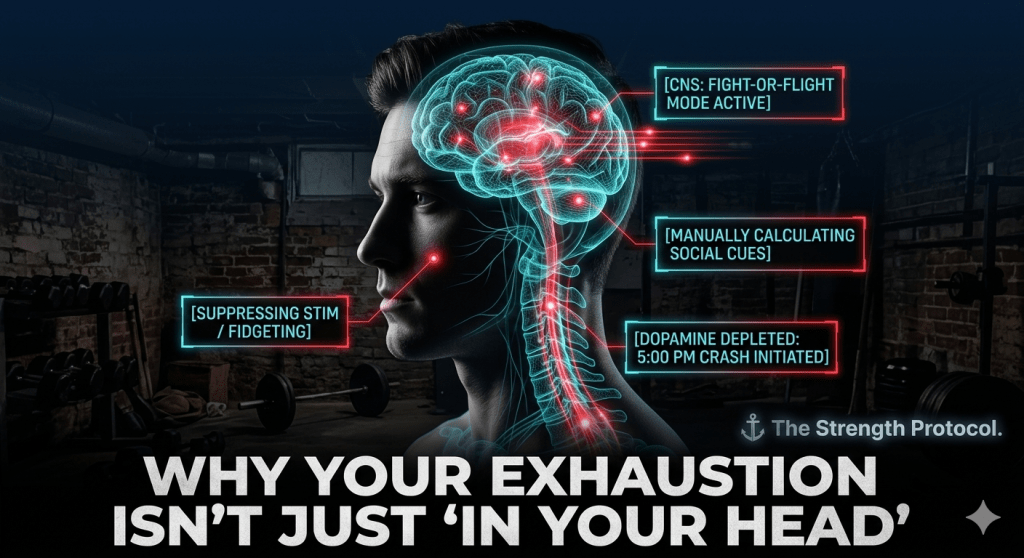
The Physical Cost of Masking: Why Your Exhaustion Isn’t Just “In Your Head”
If you have spent the majority of your life operating an ADHD brain without a clinical diagnosis, or if you received your diagnosis later in adulthood, you have likely become a master at something that is quietly destroying your central nervous system. You have learned how to mask.
Masking is the constant, conscious, and exhausting effort to suppress your natural neurodivergent traits to fit seamlessly into a neurotypical environment. [1][2] It can leave you feeling drained and overwhelmed, making your homecoming feel like a relief from the emotional weight carried throughout the day. When you finally get home at 5:00 PM, walk through the door, and completely collapse on the couch—unable to initiate even the simplest task like taking off your shoes or making a decision about dinner—that is not laziness. It is not a character flaw. It is a catastrophic failure of your central nervous system. Your battery did not just drain naturally over the course of the day; it completely short-circuited under an unmanageable load.
As a certified Nurse Practitioner (NP-C), I see the clinical reality of this exhaustion every single day. The medical community often focuses heavily on the behavioral symptoms of ADHD—the distraction, the forgetfulness, the impulsivity. [3] But what is rarely discussed with the depth it deserves is the profound physical toll that masking takes on the human body. Recognizing this can help healthcare professionals better understand the invisible strain their patients experience, fostering empathy and more effective support. We need to stop treating ADHD burnout as a purely psychological hurdle and start addressing it for what it actually is: a physiological crisis.
This deep dive aims to challenge neurotypical advice, explain the neurobiology behind your exhaustion, and introduce practical strategies-like mindfulness, scheduled breaks, or neurodivergent-friendly routines-that can help manage the physical toll of masking.
Part I: The Anatomy of the ADHD Mask
To understand why you are so physically exhausted, we first have to dissect what masking actually requires of your brain.
For a neurotypical individual, navigating a standard day—sitting in a meeting, making small talk at the water cooler, following a linear conversation, or sitting still at a desk—requires very little conscious cognitive effort. Their brains are wired to perform these tasks on autopilot. Their executive function handles the background processing automatically, leaving their primary cognitive energy free for actual problem-solving and work. [4][5]
For the ADHD brain, none of this is automatic. Every single “normal” behavior requires a manual, conscious command. [3][6]
Masking looks like forcing eye contact when it is physically uncomfortable or distracting. It is actively suppressing the overwhelming urge to move, fidget, or stim when your body is practically vibrating with restless energy. It is the hyper-vigilant monitoring of a conversation—constantly calculating when it is your turn to speak, desperately trying to hold onto your thought without interrupting, and manually interpreting social cues that do not come naturally. It is hiding your hyper-fixations so you do not seem “too intense.”[1][2]
Think of your brain like a smartphone. A neurotypical brain has one or two apps running in the background. An ADHD brain attempting to mask in a neurotypical environment has fifty complex, high-drain applications running simultaneously to maintain the appearance of a functioning home screen.
This is an immense cognitive load. You are running a constant background algorithm to calculate how you are perceived, adjusting your behavior in real time and suppressing your natural neurological impulses. You are not just doing your job or going to school; you are simultaneously performing a one-person play where you are the lead actor, the director, and the harsh critic all at once.
Part II: The Neurochemistry of the 5:00 PM Crash
When we look at masking through a clinical lens, the resulting exhaustion makes perfect biological sense. The ADHD brain is already operating with a structural deficit in specific neurotransmitters, primarily dopamine and norepinephrine. [7][8][5] These are the chemicals responsible for motivation, reward, focus, and, critically, executive function. [4][5][9]
When you mask, you are forcing an already dopamine-starved system to work in overdrive. You are burning through your limited neurotransmitter reserves at an astronomical rate just to maintain a baseline of “acceptable” behavior. [7][8]
But it gets worse. Because masking is unnatural and requires constant vigilance, it acts as a chronic, low-grade stressor on the body. Your brain perceives this constant need to monitor and adjust as a threat state. This triggers the sympathetic nervous system—your fight-or-flight response.[10][11]
Throughout the day, as you suppress your neurodivergent traits, your body is quietly pumping out cortisol and adrenaline. [10][12] You are essentially surviving the workday on stress hormones. This is why you might feel highly capable, sharply focused, or even anxious in the environment (the office, the social gathering). The adrenaline is masking the dopamine deficit. [10][11]
But stress hormones are designed for short bursts of survival, not eight-hour shifts. [10][11] When you finally leave that environment—when you get to your car, or when you walk through your front door—the perceived “threat” is gone. The adrenaline drops. The cortisol production halts.[10][12]
And underneath that chemical scaffolding? There is nothing left. The dopamine is gone. The norepinephrine is depleted. [7][8] The central nervous system (CNS) experiences a massive, immediate crash.
This is the 5:00 PM couch paralysis. Your brain literally does not have the chemical fuel required to initiate the next sequence of actions. [4][5] You cannot get up to cook dinner because the neurotransmitters required to formulate that plan, break it down into steps, and send the signal to your muscles to move are completely tapped out. You are not lazy. You are clinically, neurochemically empty.
Part III: The Central Nervous System Under Siege
The long-term cost of this daily cycle is severe. When the central nervous system is subjected to chronic masking, it enters a state of dysregulation. [11][13][12]
A healthy nervous system is resilient. It can easily shift between the sympathetic state (action, stress, fight-or-flight) and the parasympathetic state (rest, digest, recover). An ADHD brain that has been masking for decades loses this elasticity. [11][13] The CNS becomes brittle.
When your CNS is dysregulated, your sensory processing goes haywire. Things that might normally be a minor annoyance suddenly feel like physical pain. The hum of the refrigerator, the texture of a certain fabric, or multiple people talking at once can trigger disproportionate rage or panic. This is sensory overload, and it is a direct symptom of a fried nervous system. [14][15][16]
Furthermore, a dysregulated CNS destroys your sleep architecture. Even though you are bone-tired, your brain cannot transition into the deep, restorative phases of sleep because it is still wired from the day’s stress hormones. [10][13] You wake up the next morning feeling like you were hit by a truck. You have to restart the masking cycle from scratch with an even lower battery.
Over the years, these compounds have led to severe ADHD burnout. You lose your passion for your hyper-fixations. Your working memory deteriorates. Your emotional regulation becomes nonexistent. You start dropping balls at work, in your relationships, and in your personal health. [1][3][2]
Part IV: Why Traditional “Rest” Fails the ADHD Brain
When you hit this level of burnout, the standard advice from neurotypical society is to “take a break,” “relax,” or “practice self-care.” They tell you to take a bubble bath, sit on the couch, watch a movie, and do absolutely nothing.
For a neurotypical person whose exhaustion stems from simply doing too many physical tasks, sitting still works. But for the neurodivergent brain, unstructured “doing nothing” is a trap that actually deepens executive dysfunction. [4][5]
When you remove all structure, all demands, and all external stimuli, your dopamine levels plummet even further. [7][8] Unstructured time is the enemy of the ADHD brain. You don’t feel relaxed; you feel a creeping, paralyzed anxiety. You know there are things you should be doing, but without the external pressure to initiate them, you are trapped in a state of inertia. [4][5]
This is why Sunday afternoons are often the most anxiety-inducing part of the week. The scaffolding of the workweek is gone, and the prospect of having to self-initiate a return to the masking environment on Monday morning creates a slow-building panic.
You cannot out-think this paralysis. You cannot journal your way out of a dopamine deficit. You cannot simply “discipline” a fried central nervous system into working harder. If the cognitive engine is completely dead, trying to use cognitive strategies (like making another to-do list or trying a new planner) is like turning the key in a car with no battery.
You have to bypass the cognitive system entirely. You have to reboot the machine.
References
- Relations Between Social Camouflaging, Life Satisfaction, and Depression Among Polish Women With ADHD. Wicherkiewicz F, Gambin M. Journal of Autism and Developmental Disorders. 2024;:10.1007/s10803-024-06410-6. doi:10.1007/s10803-024-06410-6.
- Diagnosis Acceptance, Masking, and Perceived Benefits and Challenges in Adults With ADHD and ASD: Associations With Quality of Life. Wurth P, Fuermaier AB, Strand AH, Thorell LB. Frontiers in Psychiatry. 2025;16:1668780. doi:10.3389/fpsyt.2025.1668780.
- Diagnostic and Statistical Manual of Mental Disorders. Dilip V. Jeste, Jeffrey A. Lieberman, David Fassler, et al. American Psychiatric Association (2022).
- Toward a New Understanding of Attention-Deficit Hyperactivity Disorder Pathophysiology: An Important Role for Prefrontal Cortex Dysfunction. Arnsten AF. CNS Drugs. 2009;23 Suppl 1:33-41. doi:10.2165/00023210-200923000-00005.
- Neurobiology of Executive Functions: Catecholamine Influences on Prefrontal Cortical Functions. Arnsten AF, Li BM. Biological Psychiatry. 2005;57(11):1377-84. doi:10.1016/j.biopsych.2004.08.019.
- Adult Attention-Deficit Hyperactivity Disorder: Key Conceptual Issues. Asherson P, Buitelaar J, Faraone SV, Rohde LA. The Lancet. Psychiatry. 2016;3(6):568-78. doi:10.1016/S2215-0366(16)30032-3.
- Adult Attention Deficit–Hyperactivity Disorder. Volkow ND, Swanson JM. The New England Journal of Medicine. 2013;369(20):1935-44. doi:10.1056/NEJMcp1212625.
- The Roles of Dopamine and Noradrenaline in the Pathophysiology and Treatment of Attention-Deficit/Hyperactivity Disorder. Del Campo N, Chamberlain SR, Sahakian BJ, Robbins TW. Biological Psychiatry. 2011;69(12):e145-57. doi:10.1016/j.biopsych.2011.02.036.
- The Neuropsychopharmacology of Attention-Deficit/Hyperactivity Disorder. Pliszka SR. Biological Psychiatry. 2005;57(11):1385-90. doi:10.1016/j.biopsych.2004.08.026.
- The Human Stress Response. Russell G, Lightman S. Nature Reviews. Endocrinology. 2019;15(9):525-534. doi:10.1038/s41574-019-0228-0.
- Neural Control of Chronic Stress Adaptation. Herman JP. Frontiers in Behavioral Neuroscience. 2013;7:61. doi:10.3389/fnbeh.2013.00061.
- The Neuroendocrinology of Stress: The Stress-Related Continuum of Chronic Disease Development. Agorastos A, Chrousos GP. Molecular Psychiatry. 2022;27(1):502-513. doi:10.1038/s41380-021-01224-9.
- The Effects of Chronic Stress on the Human Brain: From Neurotoxicity, to Vulnerability, to Opportunity. Lupien SJ, Juster RP, Raymond C, Marin MF. Frontiers in Neuroendocrinology. 2018;49:91-105. doi:10.1016/j.yfrne.2018.02.001.
- Sensory Processing in Individuals With Attention-Deficit/Hyperactivity Disorder Compared With Control Populations: A Systematic Review and Meta-Analysis. Jurek L, Duchier A, Gauld C, et al. Journal of the American Academy of Child and Adolescent Psychiatry. 2025;:S0890-8567(25)00209-6. doi:10.1016/j.jaac.2025.02.019.
- Emotional and Sensory Dysregulation as a Possible Missing Link in Attention Deficit Hyperactivity Disorder: A Review. Grossman A, Avital A. Frontiers in Behavioral Neuroscience. 2023;17:1118937. doi:10.3389/fnbeh.2023.1118937.
- The Hippocampus-Ipl Connectivity Links to ADHD Traits Through Sensory Processing Sensitivity. Zhou L, Xu T, Feng T. Cerebral Cortex (New York, N.Y. : 1991). 2025;35(3):bhaf063. doi:10.1093/cercor/bhaf063.
 Strength Society
Leave a comment