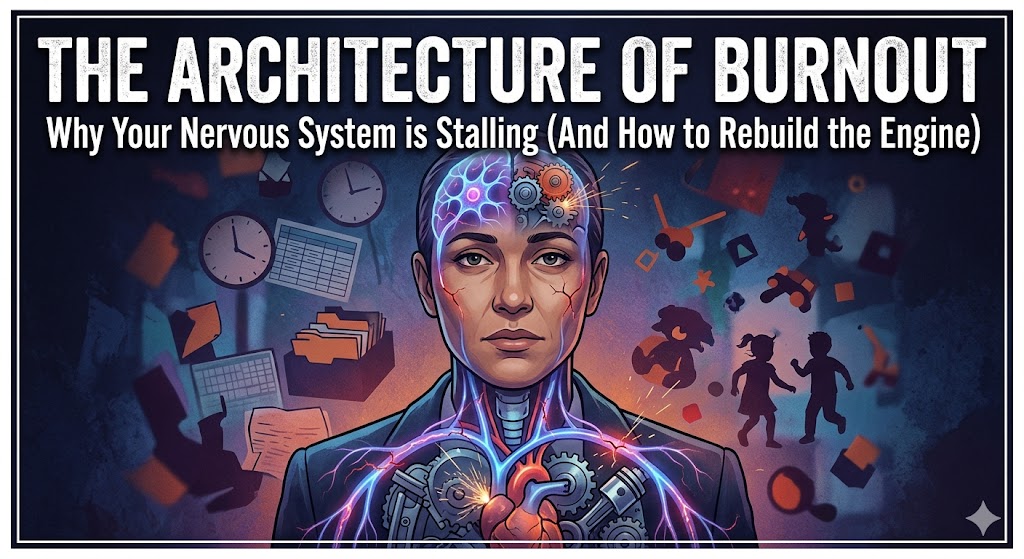
Burnout is a biological problem, but people often try to solve it only with mental or emotional strategies.
If you are in your 30s to 50s and were recently diagnosed with ADHD or severe executive dysfunction, you might have spent years thinking you were lazy or unmotivated while trying to fit into society’s idea of success.
This experience puts a lot of strain on your central nervous system.
Discipline is not the problem. The real challenge is finding the right words to explain what you are going through.
Society often judges ADHD by what it sees: scattered focus, missed deadlines, and bursts of intense focus followed by crashes. People see these as personal failings. But ADHD is not just about behavior; it is a real, biological condition. It is like trying to run a powerful engine on the wrong fuel, getting stuck, and blaming yourself when things do not work.
Instead of trying to reason with your feelings, start paying attention to your biology. This guide will show you why your system is struggling and what you can do to rebuild it.
Part 1: The Biological Reality of the Neurodivergent Engine
To solve this problem, you first need to understand how your brain works.
The neurotypical brain operates on a baseline level of dopamine and norepinephrine that allows for steady, consistent, low-friction execution of daily tasks. They can wake up, decide to do administrative work, and their brain supplies the necessary neurochemicals to initiate and complete that work.
Your brain functions in its own unique way. The Dopamine Deficit
An ADHD nervous system shows lower levels of two key brain chemicals: dopamine and norepinephrine. These neurotransmitters, which are chemicals that help nerve cells communicate, are needed for the brain to function smoothly. In particular, the prefrontal cortex—the part of the brain that helps with planning, initiating tasks, and regulating emotions—needs sufficient norepinephrine and dopamine to function well. It does so through specific receptors: postsynaptic alpha-2A-adrenoceptors for norepinephrine and D1 receptors for dopamine. When people with ADHD do not have enough of these chemicals, their prefrontal cortex becomes less effective at managing attention, behavior, and emotions.
For example, at 9 AM, you might have a spreadsheet to work on. Your colleague gets started easily, but you find it hard to begin. This is because of your brain chemistry, not a lack of motivation.
Because your brain does not have enough of these important chemicals, you naturally look for situations that help your brain make more of them. This is why the ADHD brain gravitates toward high-stimulation or “crisis” environments. During a crisis, the sympathetic nervous system releases norepinephrine and dopamine. For a neurotypical brain, this chemical flood can induce overwhelm. For the ADHD brain, this flood provides the neurochemical substrate the prefrontal cortex needs to come fully online.[5]
This is why you feel calm, focused, and able to perform well in high-pressure situations or emergencies, but feel stuck when you have to do routine tasks like filling out a spreadsheet.
External stimulation helps make up for the chemical differences in your brain. Important clarification: While new and urgent situations can briefly raise dopamine, a brain chemical involved in motivation and reward, the link between ADHD and stress is complex. Research on “cortisol reactivity”—how the body releases cortisol, a hormone produced during stress—is mixed. Some studies show adults with ADHD have stronger-than-normal stress reactions; others, especially those with children who have ADHD and behavior concerns, show weaker reactions. Long-term stress makes ADHD problems worse, so always relying on urgency is not a good approach.
In daily life, using constant urgency or last-minute pressure might help you focus for a short time, but it puts too much stress on your nervous system. Over time, this leads to burnout, more trouble focusing, and feeling like you are always trying to recover. If you depend on crisis to get things done, life can turn into a cycle of exhaustion instead of steady energy.
Part 2: The Two Fronts of Friction
Many adults diagnosed later in life were made to feel that their natural way of thinking was wrong. You were told to fit in and that being mature meant sitting still, climbing the career ladder, and doing slow, routine tasks.
This pressure can lead to burnout both at work and at home.
Front #1: The Career Trap
People with ADHD often do well in jobs like emergency medicine, the military, first responder roles, high-stakes sales, and entrepreneurship. These jobs offer variety and excitement, which help the ADHD brain get the stimulation it needs to start tasks.
But what changes when you reach your 30s and 40s?
You get promoted and move from fieldwork to the office. Instead of “hunting” and handling crises, you now manage projects, handle administration, and oversee long-term tasks.
Biologically, your brain is no longer getting the dopamine it needs.
For example, you might have spent 10 years as a field technician,n solving urgent problems and thriving in chaos. Now, as a project manager, you spend six6 hours a day in meetings and updating spreadsheets. By 2 PM, you feel exhausted just from trying to focus, while your colleagues seem fine. You end up feeling broken.n.
Your new job has more routine and fewer exciting tasks. Every day, you try to do administrative work, but your brain does not get enough stimulation. This mismatch makes it hard to focus and finish your work.
Burnout is not just about having too much work. It can also happen when your brain chemistry does not match your environment, making it hard to stay focused.
Front #2: Parenting and Sensory Overload
After work, you face another challenge: parenting and managing your home.
Parenting is one of the most demanding tasks for executive function. It requires constant switching between tasks, managing emotions, keeping schedules, and doing many low-dopamine chores like laundry, meal prep, and cleaning.
1. The Executive Drain: You spent your entire workday masking your symptoms and forcing your brain to function in an unnatural environment. Your biological battery is completely flat. When you get home, your children require the exact executive functions (patience, task initiation, emotional regulation) that you entirely depleted at the office. Parent-reported executive function difficulties in children with ADHD are strongly associated with parenting stress, especially with emotional control, inhibition, monitoring, and shifting—the very functions you have depleted.[9][10]
2. Sensory Overload: The ADHD brain has trouble filtering out distractions. Loud noises, sudden touches, and many demands from children can feel overwhelming.[11]
For example, your 6-year-old asks for help, your 3-year-old cries, and the dog barks. Each demand puts more strain on your nervous system. You might react sharply and then feel guilty. This is sensory overload, not a personal failure.
That is why, when the house is finally quiet at 8:00 PM, you may need some time alone to recover and let your nervous system reset before bed.
By 10:00 PM, after a long day, your brain starts seeking stimulation. You might scroll on your phone, start new projects, or try new things late at night. This gives you a burst of energy, even though your body still needs rest.
Part 3: The Mechanical Solutions (Rebuilding the Architecture)
You cannot out-think this problem. You cannot solve this problem just by thinking harder. Meditation or planning tools alone will not fix a nervous system that is always on high alert. Therapy and medication are important for managing ADHD, but these practical steps are here to support your treatment and help you in daily life. If changing everything at once feels too much, that is completely normal. Start with just one tiny, manageable action. Even a single step—like making a high-protein breakfast or moving for five minutes—counts as real progress. Change works best when it feels possible, not overwhelming. You do not have to do it all at once; just beginning with one small thing is enough.
System 1: The CNS Reset and Physiological Dominance
The problem right now is that your nervous system is controlling your actions.
The solution is to use physical strategies to regain control and help your body feel more balanced.
When your mind feels out of control, whether from parenting stress or work tasks, a strong physical reset can help.
Heavy Resistance Training
Lifting heavy weights is not just for building muscle; it is also a powerful tool for people with ADHD. Studies show that exercise can help with key ADHD symptoms, like trouble paying attention, being too active, and acting on impulse. It also supports brain skills such as working memory, flexible thinking, and self-control in both children and adults. However, you do not have to lift heavy weights to get these benefits. Any form of movement—walking, stretching, bodyweight exercises, or adapted routines—can be helpful. If you have physical limitations or are new to exercise, start with what feels manageable for your body. All movement counts, and modifications are more than okay. The most important thing is to find an exercise you enjoy and can stick with.
Research shows that regular exercise leads to moderate to large improvements in attention, hyperactivity, impulsivity, anxiety, executive function, and social skills. Lifting heavy weights requires your full focus, helping your mind lock onto one demanding physical task.
Why it works for ADHD brains:
- Forces complete mental focus on a single, high-stakes task.
- Provides immediate dopamine release
- Burns off excess stress hormones
- Creates a sense of accomplishment and progress
Resistance training also helps balance your nervous system. Intense exercise burns off extra stress hormones from the day and helps your body move into a calmer, more restful state.
Temperature and Pressure Protocols
Cold exposure: A cold exposure protocol can trigger norepinephrine release, providing a neurochemical spike that can help activate the prefrontal cortex.
Deep pressure therapy: Using a weighted blanket can trigger the parasympathetic nervous system, reducing arousal and facilitating sleep.
Practical implementation:
- Start with 30-60 seconds of cold water at the end of your shower.
- Use a 15-20 lb weighted blanket during your evening wind-down routine.
- Try different approaches to see what works best for your nervous system.
System 2: Neuro-Fuel Nutrition
The problem is that your brain uses more energy than any other part of your body. If you do not give it steady, healthy fuel, your nervous system will have a hard time.
When you skip meals or rely on quick-digesting carbs to get through the day, your blood sugar goes up and down. Each time your blood sugar drops, your body releases cortisol and adrenaline to get more energy.
If you do not eat well, you can make your body feel stressed without realizing it. For someone with ADHD, low blood sugar can make you feel irritable and impulsive.
The Protein Threshold
Protein should be viewed not just as muscle fuel, but as foundational nutrition for stable energy and satiety. As a simple guideline, most adults benefit from aiming for around 20 to 30 grams of protein per meal or a daily total of approximately 0.7 to 1 gram of protein per pound of body weight, spaced throughout the day. While tyrosine and phenylalanine are precursors for dopamine and norepinephrine synthesis, research has not found deficiencies in these amino acids in children with ADHD, and clinical trials of amino acid supplementation have not demonstrated consistent benefits for ADHD symptoms.[17][18][19][20]
However, getting enough protein helps keep your blood sugar steady, reduces impulsive eating, and gives you lasting energy. These are all important for managing ADHD challenges during the day.
Practical protein sources (minimal prep required):
- Breakfast: Greek yogurt with nuts, scrambled eggs, protein shake
- Lunch: Rotisserie chicken, canned tuna or salmon, pre-cooked lentils
- Snacks: Cottage cheese and fruit, hard-boiled eggs, edamame
- Dinner: Grilled chicken breast, tofu stir-fry, lean ground beef
Quick meal ideas:
- Greek yogurt (20g protein) + handful of almonds + berries = 5-minute breakfast
- Rotisserie chicken + microwaveable rice + steam-in-bag vegetables = 10-minute lunch
- Protein shake + banana + peanut butter = 2-minute snack
Keeping ready-to-eat protein available can help you get what you need without having to make extra decisions.
Strategic Carbohydrates are not bad; they can actually help you. Eating complex carbs and healthy fats in the morning keeps your blood sugar steady and helps prevent energy crashes that make it harder to focus and manage your emotions.
The 2 PM crash prevention strategy:
- Morning: Complex carbs (oatmeal, whole grain toast) + protein + healthy fats
- Midday: Balanced meal with protein, vegetables, and moderate carbs
- Afternoon: Protein-focused snack to stabilize energy
System 3: Standardizing the Architecture
The problem is that making too many decisions is exhausting for people with ADHD.
Every time you decide what to eat, what to wear, or how to exercise, you use up some of your mental energy. By the afternoon, all these small choices can leave you feeling drained. The solution is to remove as many unnecessary choices as you can.ossible.
Cognitive-behavioral therapy (CBT) for adult ADHD consistently demonstrates efficacy for reducing core symptoms and improving functioning. The most effective CBT approaches emphasize external systems, organizational skills, time management, and environmental structure—exactly the principles underlying this “standardized architecture” approach.[21][22][23][1][24] Research shows that CBT produces moderate to large effect sizes for ADHD symptom reduction, with benefits extending to depression, anxiety, and functional impairment.[22][23][24]
Build Your Daily Architecture
Nutrition System:
- Eat the same 3-4 high-protein meals on rotation.
- Prep on Sunday for the week ahead
- Keep emergency protein options always available.
Training System:
- Follow a pre-written program (no guessing)
- Train at the same time each day.
- Track your workouts in a simple log.
Morning Routine:
- Wake at the same time.
- Same breakfast
- Same workout time
- Same work start time
Evening Routine:
- Dinner at a consistent time
- Phone away by 8 PM
- Weighted blanket routine
- When you automate your daily routines, you free up mental energy for more important things. Your systems take care of the small stuff for you.
When your routines handle the basics, you can use your energy and focus on what matters most: doing well at work, being present for your children, and enjoying your life.
The Rebuilding Phase
It is normal and healthy to feel sad or angry about the years lost to executive dysfunction. It is okay to grieve the time you spent feeling broken or lacking support.
But you do not have to stay in that place of grief forever.
You can feel sad about the past and still work on building better routines for your future. Both feelings are valid.
Things may feel broken, but you can still make real changes. Remember, there is no one right way to move forward, and it is perfectly okay to adapt, pause, or do the challenge at your own pace. Try to treat yourself with the same compassion you would offer a friend: progress is not about perfection, but about small, steady steps in the right direction. Instead of relying on motivation, focus on practical steps like regulating your nervous system, fueling your body, building routines, and following your plan. When you are ready, you can begin with the 7-Day Reset Challenge—or modify it in any way that best supports you.
You have learned the science and understand your brain. Now it is time to take action.
Choose ONE system to implement this week:
Option 1: The Physical Reset
- Add 3 resistance training sessions this week.
- End each shower with 30 seconds of cold water.
- Use a weighted blanket for 7 nights.
Option 2: The Nutrition Anchor
- Eat 30g of protein within 30 minutes of waking for 7 days.
- Prep 3 high-protein meals on Sunday
- Track your energy levels at 2 PM each day.
Option 3: The Decision Detox
- Wear the same outfit style for 7 days.
- Eat the same breakfast every morning.
- Follow a pre-written workout plan (no decisions at the gym)
Track your progress:
- How is your focus at work?
- How is your patience with your kids?
- How is your energy at 2 PM?
- How is your sleep quality?
Share your journey. You are not alone in this. Thousands of adults diagnosed later in life are rebuilding their lives with these same systems. Join the conversation, share your successes, and support others who are just starting out.
To find community and support, consider connecting with others in ADHD-focused forums and groups such as ADDA (Attention Deficit Disorder Association) peer support groups, CHADD support communities, Reddit’s r/ADHD, or local Meetup groups for adults with ADHD. Some mental health organizations also offer ADHD helplines where you can talk to trained volunteers. These resources can help you learn from others, share your experiences, and feel supported on your journey.
The question is not whether you can change, but which system you will start with today.
References
- Adult Attention Deficit–Hyperactivity Disorder. Volkow ND, Swanson JM. The New England Journal of Medicine. 2013;369(20):1935-44. doi:10.1056/NEJMcp1212625.
- Catecholamine Influences on Dorsolateral Prefrontal Cortical Networks. Arnsten AF. Biological Psychiatry. 2011;69(12):e89-99. doi:10.1016/j.biopsych.2011.01.027.
- Neurobiology of Executive Functions: Catecholamine Influences on Prefrontal Cortical Functions. Arnsten AF, Li BM. Biological Psychiatry. 2005;57(11):1377-84. doi:10.1016/j.biopsych.2004.08.019.
- The Emerging Neurobiology of Attention Deficit Hyperactivity Disorder: The Key Role of the Prefrontal Association Cortex. Arnsten AF. The Journal of Pediatrics. 2009;154(5):I-S43. doi:10.1016/j.jpeds.2009.01.018.
- Neuronal Mechanisms Underlying Attention Deficit Hyperactivity Disorder: The Influence of Arousal on Prefrontal Cortical Function. Brennan AR, Arnsten AF. Annals of the New York Academy of Sciences. 2008;1129:236-45. doi:10.1196/annals.1417.007.
- Cortisol Response to Acute Psychosocial Stress in ADHD Compared to Conduct Disorder and Major Depressive Disorder: A Systematic Review. Bernhard A, Mayer JS, Fann N, Freitag CM. Neuroscience and Biobehavioral Reviews. 2021;127:899-916. doi:10.1016/j.neubiorev.2021.06.005.
- Psychological and Cortisol Reactivity to Experimentally Induced Stress in Adults With ADHD. Raz S, Leykin D. Psychoneuroendocrinology. 2015;60:7-17. doi:10.1016/j.psyneuen.2015.05.008.
- Shared Biological Pathways Linking ADHD and Cortisol Variability Are Related to Externalizing Behaviors. Ramos JKN, Gravet EH, Junger-Santos I, et al. Psychoneuroendocrinology. 2025;181:107587. doi:10.1016/j.psyneuen.2025.107587.
- From ADHD Symptoms to Parental Stress: The Roles of Functional Impairment, Family Functioning, and Parental ADHD. Jongrakthanakij N, Prachason T, Limsuwan N, et al. PloS One. 2026;21(1):e0341817. doi:10.1371/journal.pone.0341817.
- Are Parent- And Teacher-Reported Executive Function Difficulties Associated With Parenting Stress for Children Diagnosed With ADHD?. McLuckie A, Landers AL, Rowbotham M, et al. Journal of Attention Disorders. 2021;25(1):22-32. doi:10.1177/1087054718756196.
- Quality of Life and Parental Stress Related to Executive Functioning, Sensory Processing, and Activities of Daily Living in Children and Adolescents With Neurodevelopmental Disorders. Lobato-Ruiz V, Romero-Ayuso D, Toledano-González A, Triviño-Juárez JM. PeerJ. 2025;13:e19326. doi:10.7717/peerj.19326.
- The Effects of Acute and Chronic Exercise on Executive Functions and Core Symptoms in Adults With ADHD: A Systematic Review and Meta-Analysis. Xu S, Zhao C, Hu L. Psychology of Sport and Exercise. 2026;84:103088. doi:10.1016/j.psychsport.2026.103088.
- Physical Exercise as Add-on Treatment in Adults With ADHD – The START Study: A Randomized Controlled Trial. Svedell LA, Lindvall MA, Holmqvist KL, Cao Y, Msghina M. Frontiers in Psychiatry. 2025;16:1690216. doi:10.3389/fpsyt.2025.1690216.
- Cardiovascular Effects of ADHD Therapies: JACC Review Topic of the Week. Torres-Acosta N, O’Keefe JH, O’Keefe CL, Lavie CJ. Journal of the American College of Cardiology. 2020;76(7):858-866. doi:10.1016/j.jacc.2020.05.081.
- Athletes With Attention-Deficit/Hyperactivity Disorder: Position Statement of the American Medical Society for Sports Medicine. Pujalte GGA, Narducci DM, Smith MS, et al. Clinical Journal of Sport Medicine : Official Journal of the Canadian Academy of Sport Medicine. 2023;33(3):195-208. doi:10.1097/JSM.0000000000001152.
- Exercise-Based Interventions for ADHD: A Review of Modalities, Mechanisms, and Practical Applications. Han JS, Jang YJ. Research Quarterly for Exercise and Sport. 2025;:1-12. doi:10.1080/02701367.2025.2581676.
- No Tryptophan, Tyrosine and Phenylalanine Abnormalities in Children With Attention-Deficit/Hyperactivity Disorder. Bergwerff CE, Luman M, Blom HJ, Oosterlaan J. PloS One. 2016;11(3):e0151100. doi:10.1371/journal.pone.0151100.
- Evaluation of Dietary Intake in Children and College Students With and Without Attention-Deficit/Hyperactivity Disorder. Holton KF, Johnstone JM, Brandley ET, Nigg JT. Nutritional Neuroscience. 2019;22(9):664-677. doi:10.1080/1028415X.2018.1427661.
- Nutrient Supplementation Approaches in the Treatment of ADHD. Rucklidge JJ, Johnstone J, Kaplan BJ. Expert Review of Neurotherapeutics. 2009;9(4):461-76. doi:10.1586/ern.09.7.
- The Diet Factor in Attention-Deficit/Hyperactivity Disorder. Millichap JG, Yee MM. Pediatrics. 2012;129(2):330-7. doi:10.1542/peds.2011-2199.
- Non-Pharmacological Interventions for Adult ADHD: A Systematic Review. Nimmo-Smith V, Merwood A, Hank D, et al. Psychological Medicine. 2020;50(4):529-541. doi:10.1017/S0033291720000069.
- Cognitive-Behavioural Interventions for Attention Deficit Hyperactivity Disorder (ADHD) in Adults. Lopez PL, Torrente FM, Ciapponi A, et al. The Cochrane Database of Systematic Reviews. 2018;3:CD010840. doi:10.1002/14651858.CD010840.pub2.
- A Meta-Analysis of the Intervention Effect of Cognitive Behavioral Therapy on Adult ADHD. Liu Y, Zhu F, Yu Y, et al. Journal of Affective Disorders. 2026;:121107. doi:10.1016/j.jad.2025.121107.
- Cognitive Behavioral Therapy Effects on Global Functioning, Domain-Specific Functioning, and Quality of Life in Adult ADHD: A Comprehensive Meta-Analysis. López-Pinar C, Selaskowski B, Schulze M, et al. Behaviour Research and Therapy. 2026;201:105026. doi:10.1016/j.brat.2026.105026.
 Strength Society
Leave a comment